

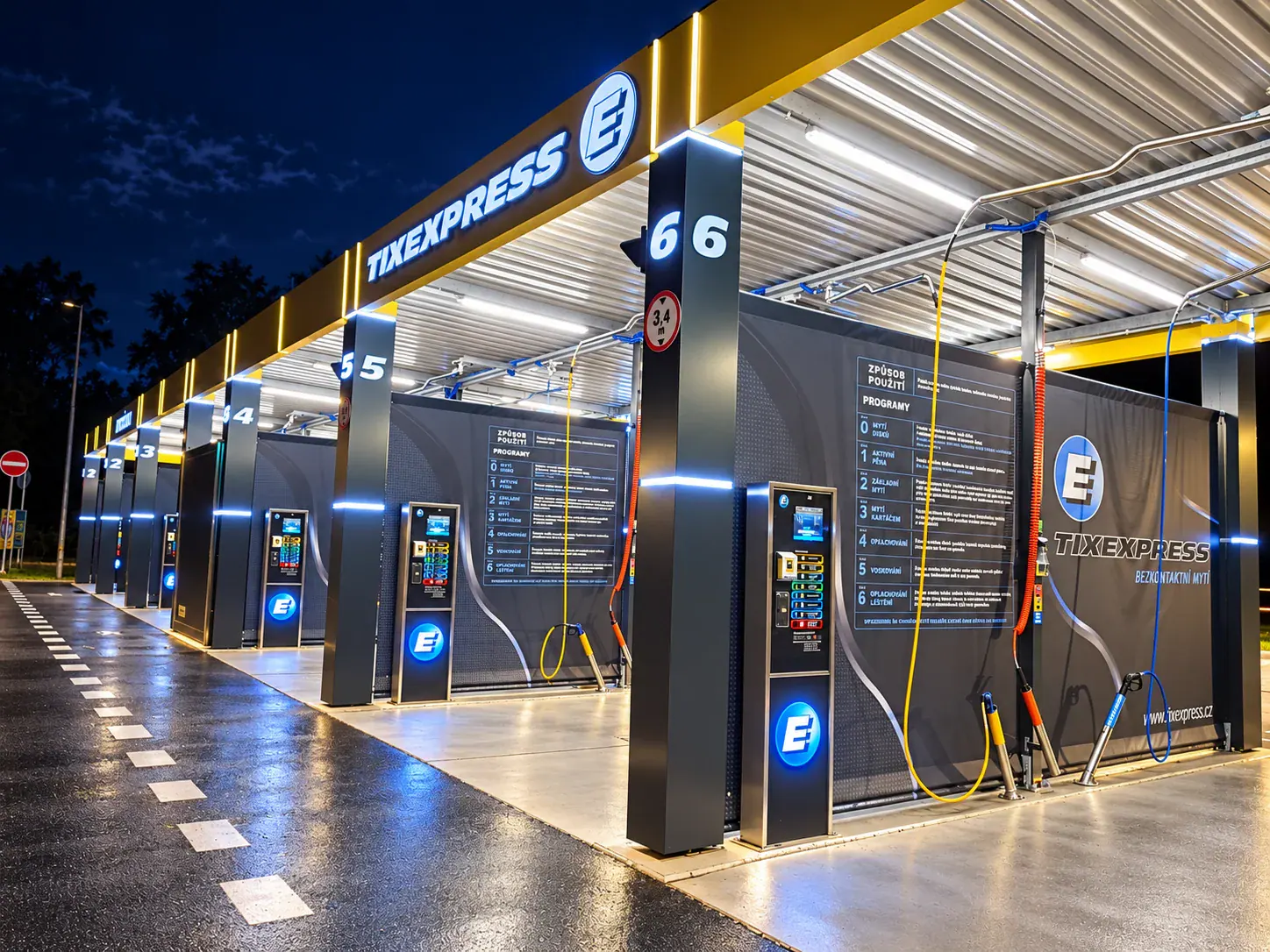
Are you choosing a two-bay or three-bay car wash, or a larger facility? The number of bays needs to reflect demand, traffic flow on the site and your development plans. Then you can select the technology, programmes, payments and canopy. This sequence helps you assess which equipment is needed from the outset and what preparations are worth making for the future.
Match the number of bays to demand and peak periods
A queue after a brief change in the weather can look very different from the traffic on a quiet morning. Both observations help you choose the right size. Two bays may meet the needs of one location, while elsewhere they could limit service at the busiest times. Four bays allow more cars to be washed at once, but require sufficient land and a sound business case.
What matters is the time a bay is occupied, not just the time spent on paid washing. The driver needs to enter, pay, put the tools back and leave. Calculation example: with a complete cycle taking 10 minutes, one bay could theoretically serve 6 cars per hour. This is a limit based on the assumed duration, with no breaks or uneven customer arrivals. It is not a sales forecast.
So also observe short surges in traffic, queues and situations where drivers decide not to wait. Compare weekdays, weekends and different weather conditions. We explain how to collect this data in our car wash location analysis. Only then should you consider a two-, three- or four-bay option.
Choose a product line for your car wash's target size
In the TIXE range , TixeRapid and TixExpress are technology and container product lines. TixeRapid serves up to three bays and cannot be expanded beyond that number. TixExpress serves up to six bays with a single container; plans for further expansion are agreed for each individual project.
| Plan | What to consider |
|---|---|
| 2 bays | TixeRapid for a small final size; if you intend a larger expansion, discuss TixExpress. |
| 3 bays | Check whether this is the final number of bays or the first phase of a larger facility. |
| 4 bays or more | Select TixExpress, equipment and installations to suit the planned size and load. |
Any expansion requirements should be included in the brief before equipment is ordered. Free space beside the car wash does not determine what the technology can support. Establish spare power capacity, installation routes, the final traffic layout and the scope of preparation. Each of these decisions should be reflected in the design and quotation.
If you are comparing the cost of a three-bay touchless car wash, use consistent assumptions for equipment and site preparation. The structure of the investment itself is discussed in our construction cost guide; here, we first define the option to be priced.
See where the technology is housed
These examples show two ways of arranging the equipment area and bays. Choose the product line to match the project's target size.
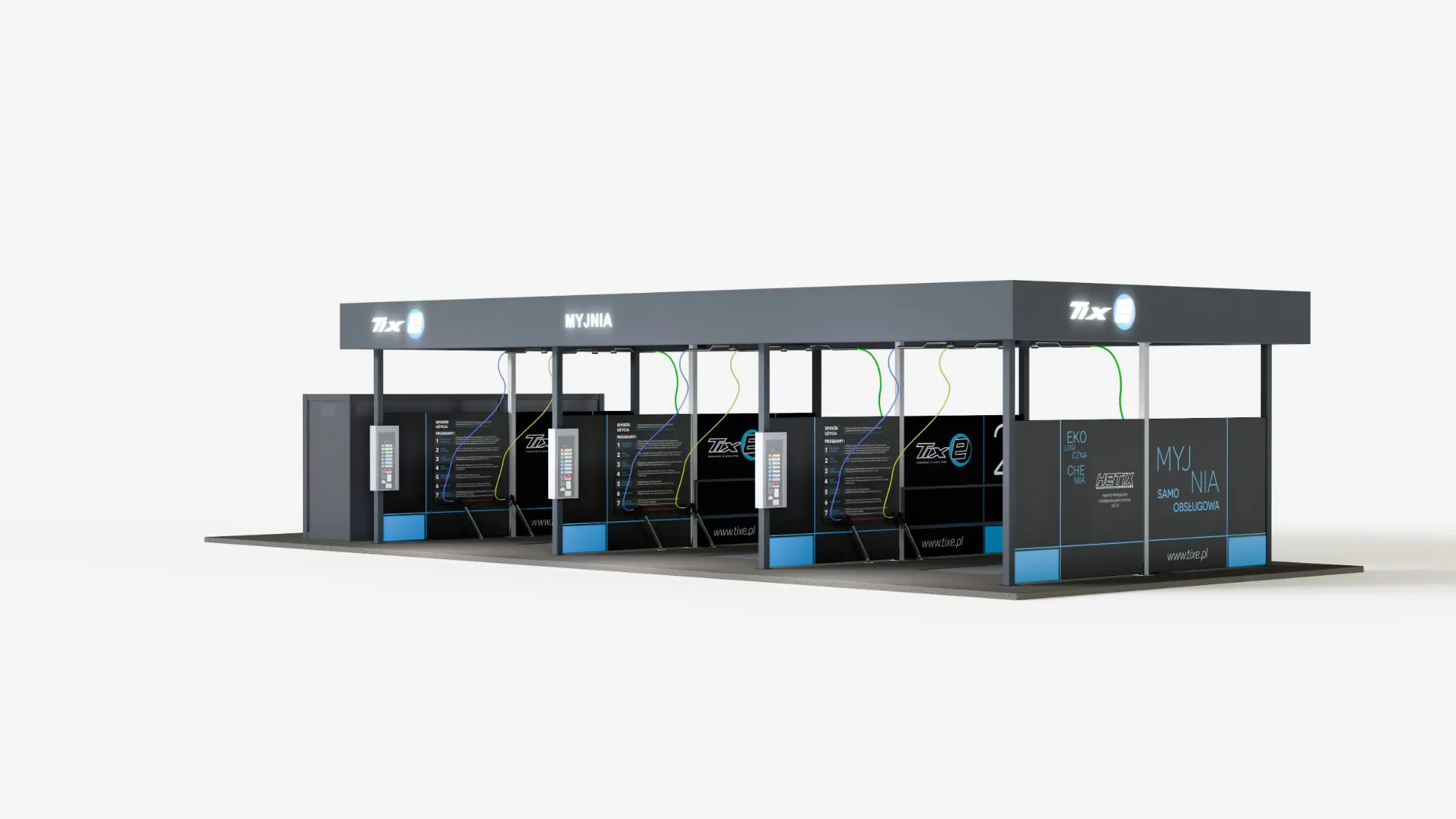
TixeRapid
SIMPLE · three-bay example- In the visualisation
- The technical container sits outside the row of bays.
- When choosing a product line
- A solution for a target size of up to 3 bays. No expansion beyond this number.
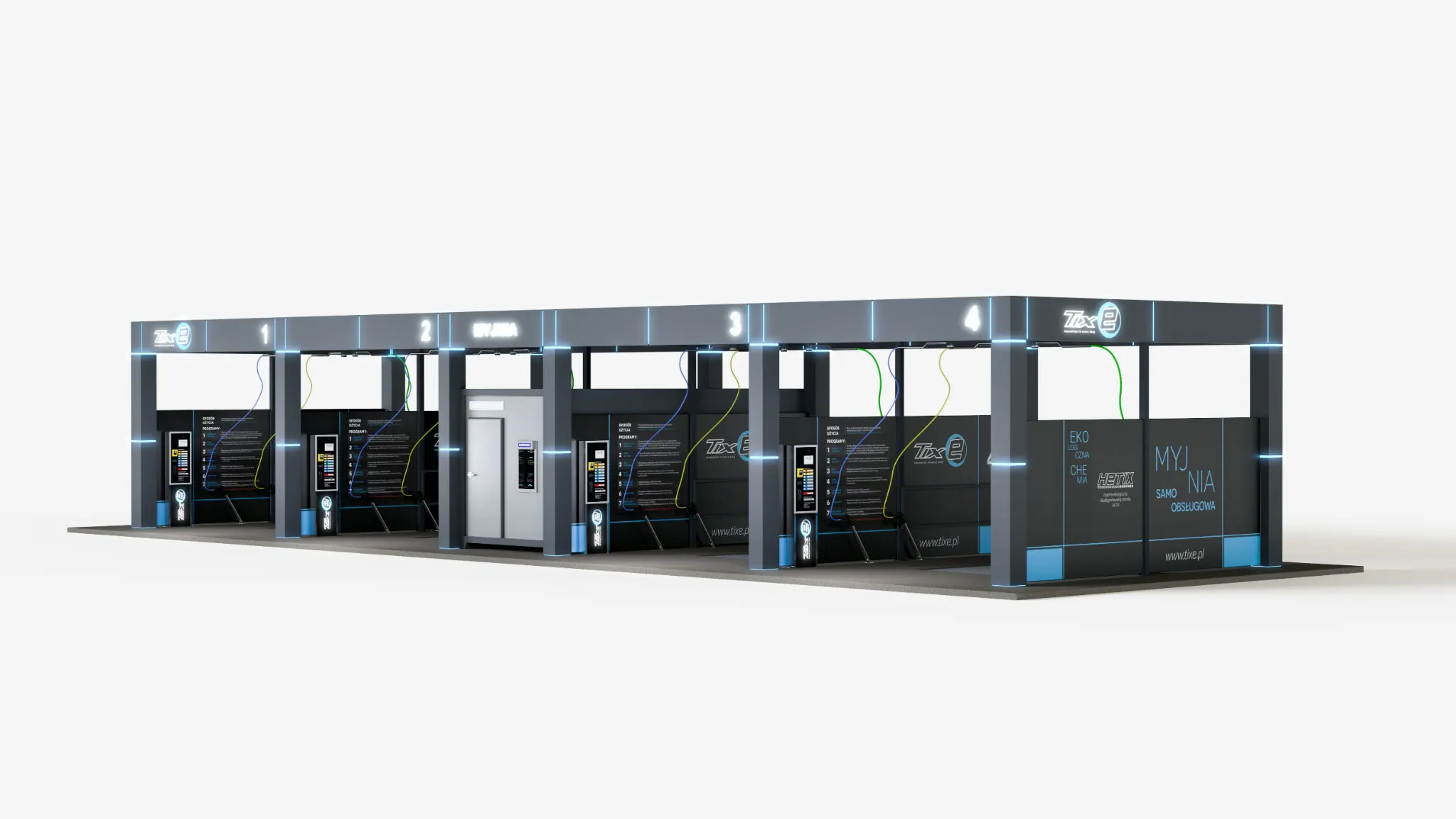
TixExpress
Four-bay example- In the visualisation
- The technical container is integrated into the structure between the bays.
- When choosing a product line
- Up to 6 bays with a single container. The scope of preparation for expansion is agreed for each individual project.
Tell us the location and planned number of bays. We will identify a starting point for the discussion.
Free analysisChoose services that drivers can use with confidence
A driver entering a bay for the first time should quickly understand where to start and which programme to choose next. The configuration must therefore cover the whole washing process, from treating the dirt to the final rinse. Equipment and tools are then selected to suit this sequence. Clear instructions, names and markings also make extensive equipment easier to use.
Distinguish between a programme and the technology that enables it to work. In TIXE solutions, TOP GUN can be associated with the main lance wash, and DOUBLE POWER with foaming in the brush programme. The final rinse with reverse-osmosis water is another function that requires water treatment. Descriptions are available in the wash technologies and programmes section.
For each additional service, establish where the customer puts the tool back, how they identify the correct lance and whether they can move freely around the vehicle. Also check the operating tasks: inspection, cleaning and topping up products. A programme's value depends on its usefulness and correct operation, not the length of the list on the panel.
A practical programme layout and guidance on the washing sequence are also highlighted in the Kärcher manufacturer's guide. This is a principle worth checking when reviewing any proposed configuration.
Look at the bay from the customer's perspective
Each of these elements affects everyday use of the car wash. Discuss them alongside the programme and equipment list.
Panel and payment
Check how clearly programmes are selected and how washing is started and paid for.
Lances and hoses
Pay attention to the position of tools, where they are put back and the freedom to move around the car.
Partitions and signage
Agree on the appearance of the partitions, signage and the elements included in the canopy you order.
Let's discuss the equipment your location needs.
Call PiotrCheck the supporting infrastructure before finalising your equipment list
The programmes must work with the conditions on the actual site. A technical discussion therefore requires the available electrical capacity, water supply parameters, wastewater disposal arrangements and the chosen heat source. If this information is not yet available, mark it as to be confirmed. Do not substitute specifications from another installation.
When considering water management, distinguish the roles of the equipment. Preparing water for the final rinse, using reverse-osmosis reject water and treating wash water each need a separate discussion. Investors need to know where the water goes, what it can be used for and who operates the whole system. Our guide explains the details of reverse osmosis and water recovery.
Allow for winter conditions and service access. Ask how the installations are protected, how heating is monitored and what is required of the operator. Do not select settings solely for the lowest short-term bill. Parameters should follow the documentation, configuration and recommendations of the team responsible for commissioning.
Plan a convenient visit from entry to exit
For the customer, payment is the start of the service. For the owner, it also involves settlement, connectivity and the terms agreed with the operator. Terminal selection should combine both perspectives: ease of use in the bay, transaction monitoring and the cost of the service. The quotation should show the device, activation, subscription and transaction fee separately where these apply to the chosen model.
Additional services change how the site is used. A vacuum cleaner beside the exit route needs a space where a car can stay while it is cleaned without blocking other traffic. Access to the change machine and interior-care equipment requires similar attention. A drawing showing vehicles helps identify conflicts that can be difficult to spot on an equipment-only layout.
Before making your choice, ask whether a new user will understand the process without further explanation. Clear prices, instructions and contact details are as tangible as the equipment list. In the industry publication Professional Carwashing & Detailing , ease of use and payments are identified as important areas of development for self-service car washes. Adapt them to your location's customers, without automatically copying solutions from a large facility abroad.
Consider the car wash's appearance separately from its technology line
SIMPLE, SIMPLE PREMIUM, QUADRA and MODERNA describe TIXE canopy styles. Choosing a style concerns a different part of the investment from choosing TixeRapid or TixExpress. The appearance must then be coordinated with the number of bays, the specific structure and equipment.
On the visualisation, mark the features you want to include in your design: colours, partitions, lighting and signage. Then check which are included in the price. A completed-project photo is a good starting point for discussion, but the specification confirms the scope of supply.
The layout should also allow for queuing, driving through, service access and space to operate the equipment. Do not assess the plot solely on whether the canopy's rectangular footprint fits. A complete concept is prepared for the actual site boundaries and conditions. In our guide to car wash site planning , we show which decisions should be finalised before further design work.
What does a “3+1” layout mean?
Compare two TixExpress examples. “+1” indicates an additional open-air bay without a canopy.
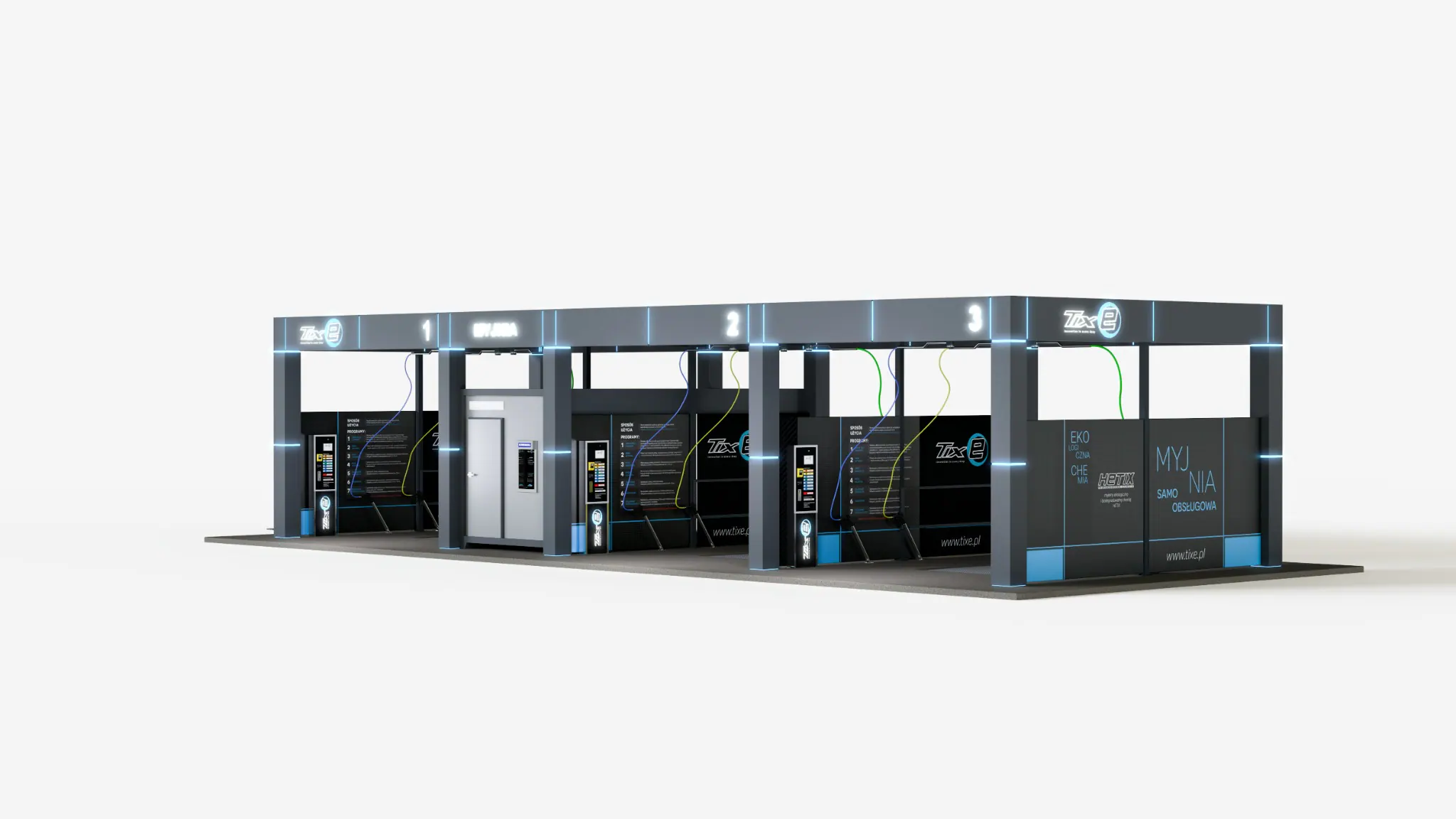
3 under a roof
In this version, all three wash bays sit under a shared canopy.
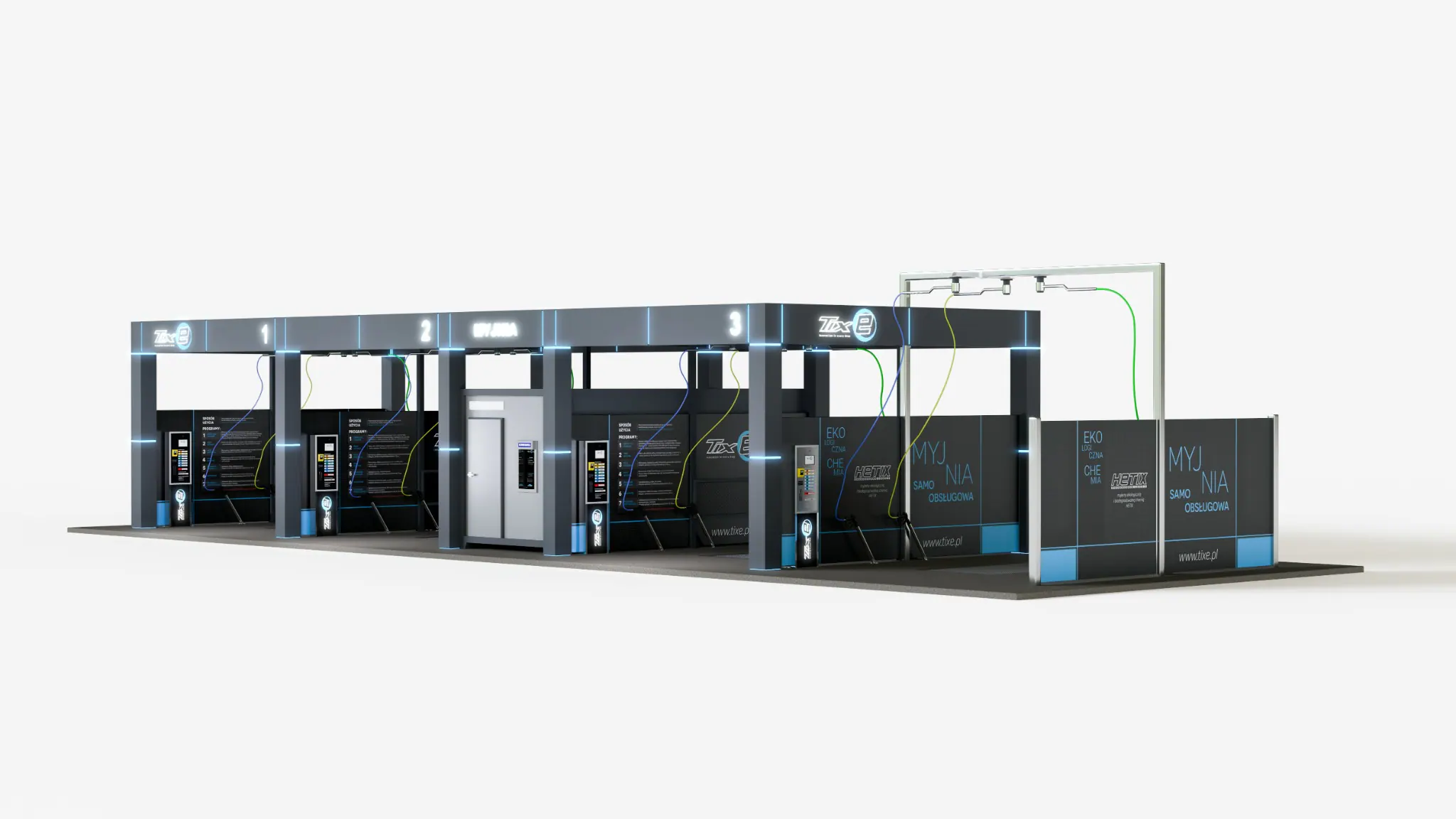
3+1, or 4 in total
Three bays are covered. The fourth has a separate hose-support frame and is open at the top.
Include the open-air bay when selecting the technology, installations and site layout. Adding it later requires arrangements to be made in advance.
Move from example layouts to the requirements for your own car wash.
Configure your car washRecord what you are opening now and what you are preparing for later
Phasing a project is clear when the first phase has a defined scope and preparations for future functions are described. These may involve space, pipework, electrical supply, controls or specific spare equipment capacity. Each solution leaves a different list of tasks for later. That is why “retrofitting possible” needs an explanation of what will be done now.
Agree on a single dated version of the drawing, quotation and equipment schedule. If you change the number of bays or the container position, revisit the installation and traffic requirements. If you add a programme, also check the tools, markings and user instructions.
At this stage, it is worth discussing your location and business plan with the manufacturer. TIXE's free preliminary analysis helps identify an option for further discussion. Its purpose is to connect the investor's needs with the site and technology, so the quotation describes a coherent facility.
What else do owners and investors ask?
Can a three-bay car wash be expanded later?
That depends on the product line and how the whole project is prepared. TixeRapid does not allow the number of bays to increase beyond three. If you plan a larger facility, discuss TixExpress, the site layout and the scope of installation preparation.
Are four bays always better than two?
More bays allow more customers to be served at once, but require demand, land and a suitable budget. The decision should be based on observations of the location and operating scenarios, not just the plot size.
Do all programmes and devices have to be ordered straight away?
The scope can be planned in phases if the chosen technology and design allow it. First establish the functions needed for opening, then describe precisely the preparation required for later changes.
Let's analyse
your car wash
Do you have a plot or are you considering an investment? We will prepare a free preliminary analysis and a quotation for TIXE technology. Tell us the location and share the information you already have — we will help determine the next steps.
Sources and further reading
- TIXE — TixeRapid, TixExpress and canopy designs. The scope of the technology lines and the distinction between technology and canopy style.
- TIXE — wash technologies and programmes. How programmes relate to technical solutions; selection requires confirmation of the configuration.
- Kärcher — Entry into the self-service wash system business. Manufacturer's material on planning bays, programmes and payments. We do not apply the areas or settings it gives as requirements for TIXE.
- Professional Carwashing & Detailing — Modernizing the self-serve carwash experience. Meagan Kusek, 8.06.2026. An industry perspective on payment convenience and bay usability.